“Let’s have some new cliches.” Samuel Goldwyn My friend and kindred blog spirit, Rich Siegel, writes a fantastic blog called RoundSeventeen. Recently he told me a st…
Source: Advertising.The unbearable lightness of Boaty McBoatface.
Stuff I think about instead of world domination
“Let’s have some new cliches.” Samuel Goldwyn My friend and kindred blog spirit, Rich Siegel, writes a fantastic blog called RoundSeventeen. Recently he told me a st…
Source: Advertising.The unbearable lightness of Boaty McBoatface.

“Let’s have some new cliches.”
Samuel Goldwyn
My friend and kindred blog spirit, Rich Siegel, writes a fantastic blog called RoundSeventeen. Recently he told me a story about pitching an idea. It was for the Olympics. The idea was simple. Do a campaign about the athletes that come stone last at the games. He and his partner Jerry Gentile understood the power of showing an athlete just making it to the Olympics. How that makes them the true winners of the games. It would show the real spirit that creates the Olympic flame. Just imagine the stories that could be told. They were very excited.
You can guess what happened next. It went nowhere. It died. The client went for the cliche. Conventional wisdom. The right thing. Winners breaking the tape with triumphant music. The expected. What is safe. What you have seen before, many, many times before. To those clients I say this. Eddie ‘The Eagle’ Edwards. Google the name and the film to see what you missed out on.
In the same week this all happened, I read two brilliant stories. The first was about Leicester City. This is a football team in the English Premier League that is on the verge of winning the English Premier Championship. If this happens, it will be the greatest fairytale in football. Ever.
Leicester City are battlers. Every football fan secretly loves them. They just avoid relegation. They scrap, they fight for every point. I have been to their old ground at Filbert Street. Trust me, it was a long way from the verdant, manicured pitches of Old Trafford and Anfield.
I think every football lover on the planet right now wants them to win. Why? Because it is impossible and it is not boring. As human beings we crave stories like this. The only thing we love more than patterns are when they are broken. With apologies to Manchester United, or Chelsea fans, if one of these teams won, it would be moderately exciting but entirely predictable. And that, can never match the excitement of something beyond your imagination.
The other story was the naming of a polar research ship in England. There was overwhelming support online for one name. 124,109 votes in fact. The name?
Boaty McBoatface.
So, right now, there is some poor bloody civil servant having to decide what to do. I really hope they go with this name. They probably won’t. But fuck I hope they do.
In both these examples, given the chance, human beings love something new and something different. Why? Because it makes them feel good and most importantly it’s a lot of fun. And, in breaking news, people want life to be fun. In a recent study, I just made up, fun is the number one thing that people want.
David Ogilvy once said you can’t bore consumers into buying your product. He said that 50 years ago. Today, that is far more true than when he said it.
Advertising is embracing analysis and it is important to do so. However, data isn’t going to give you stories about Olympic athletes that come last, Leicester City or Boaty McBoatface. We need to remember to embrace fun and joy just as much as certainty.
As an industry, we are at risk of telling the same stories over and over again and expecting a different result.
We will do what is correct and efficient. We will reach consensus. We will look at the data. We will make less mistakes. We also might become very boring.
We need to remember what Einstein said. Creativity is intelligence having fun. Fun is not a nice to have. It is a vital ingredient that we often forget to put into the recipe.
Human beings like the wrong things. We like impossible stories. Stories, that confirm we can all beat the odds. We like all our odd quirks, things that don’t make sense and weird shit.
As an industry we often try and smooth these rough edges over. We try and find a middle ground or an acceptable, average answer. Something we can all agree on.
Perhaps we shouldn’t.
We like these odd shaped things because we are human. In fact, that’s what makes us human.
We like all these things because they make life worth living.
I hope advertising never forgets this.
“The truth is rarely pure and never simple.” Oscar Wilde In the last month I have read countless blogs about the death of advertising. It has become fashionable to write about th… Source: And now…
“The truth is rarely pure and never simple.” Oscar Wilde In the last month I have read countless blogs about the death of advertising. It has become fashionable to write about th…
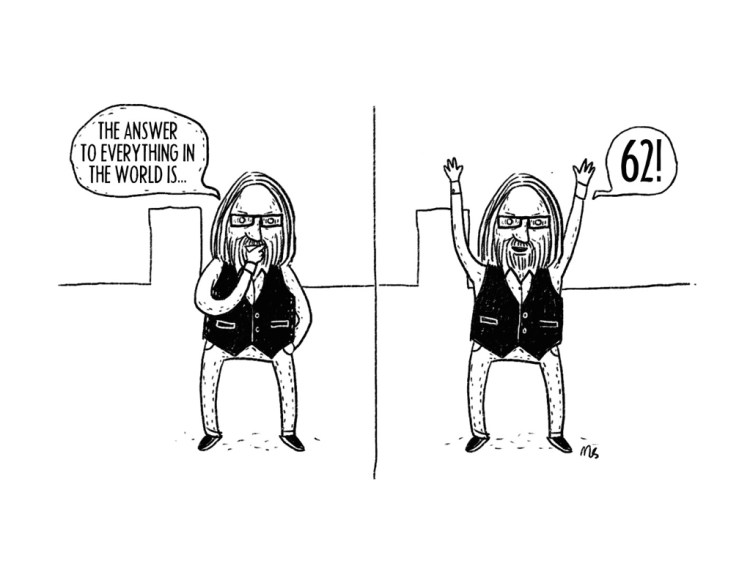
“Because an algorithm can’t come up with Popeye.”
Dave Trott
About 20 years ago for a brief moment I thought I was a genius.
I had been given a brief for a large telco company and only a day to crack it. My partner and I worked late into the night. We filled the walls of our office with ideas. Some were shit, some made no sense but a few had some promise. And there was one that we both thought was really good. As a creative you know when something is good because you feel like you want to walk out of the agency and make the idea immediately. It is a heady mix of excitement and irritation.
Great ideas are ideas you can feel.
So, the next day we walked into the ECD’s office with a little swagger. We had nailed this. We presented all the ideas and then hit him with the big one. We waited for the inevitable glory. Nothing big, perhaps a ticker tape parade, thunderous applause and being fed grapes while overlooking the Aegean would be fine.
We got nothing.
He stared at us for a long time. In fact, he stared at us for so long I wondered if he was hungover or had died with his eyes open. Alas, this wasn’t the case. He reached onto his desk for a large yellow D&AD annual and opened it to a certain page and said probably the worst words a creative can hear.
It’s been done.
It had. I had a feeling that I will try and describe.
Imagine you are going into a jail cell for the first time. You are not very strong but you are very pretty. As the cell door closes you notice two other prisoners. They seem to work out a lot. The one with the eye patch smiles and blows you a kiss. This special moment is interrupted by the warden coming by to tell you your parole had been denied. And then, as an afterthought, he says your mom phoned to let you know your cat had died.
That was the feeling. It was one one I never wanted to have again. It was a feeling that pushed me forward to try harder.
The reason I mention this dark moment in my career is that lately I have noticed a lot of work that is a direct copy of pretty famous campaigns. I have seen them being entered into Award shows. I see them winning. I have even seen Creative Directors defending why they have done it in the trade press. With all this happening, I started to wonder if as industry doing something fresh still mattered.
How important is it to still try and be authentic? Should creatives focus on being efficient first and effective second? Or is it the other way round? Should we just put any picture in those endless picture frames? Does originality, quality, emotion and feeling matter more or less than it used to? Is there a new definition of great work?
Should we still strive to make those ideas that we can feel?
While I was wondering about all this, I read two stories involving Artificial Intelligence. One was about the ad agency McCann in Japan that had created the first AI Creative Director. Essentially, it is an algorithm that looks at all the work ever made in a particular category, analyses it and gives you suggestions as to what work you should make.
The other was an article about a project called The Next Rembrandt. It was a collaboration between Microsoft, ING and Delft University of Technology. They analysed all of Rembrandt’s work pixel by pixel. Using machine learning algorithms they identified the most common patterns Rembrandt used. From this they created the first new Rembrandt in 350 years.
Now, there is no denying these developments are amazing. However, in both cases the answers or paintings that are generated are based on what exists. They are using existing data. The AI Creative Director will give you suggestions on what exists and what has worked. The advantage of that is very little risk. And perhaps, in a very fast world, that is the point. The disadvantage is you pretty much stay where you are. Risk, used to be how you got to reward. These days certainty seems to be its own reward.
The new Rembrandt I am sure is magnificent. But is it better than the original? And, is it really new? No. It’s been done. It’s just a very sophisticated copy. Is it more important than an artist in some shitty basement trying to do something authentic? No.
Picasso said computers are useless. They can only give you answers.
Answers and speed these days seem to be valued above all else.
However, I believe there is something far more valuable.
Being Human.
Being alive is something an algorithm cannot do. Not yet anyway.
And being alive, is how you feel something new.
That will always be the difference.
An algorithm might hear the music.
But we feel it.
“Sometimes you can’t see yourself clearly until you see yourself through the eyes of others.” Ellen DeGeneres Many years ago there was a small stand-up comedy club called …
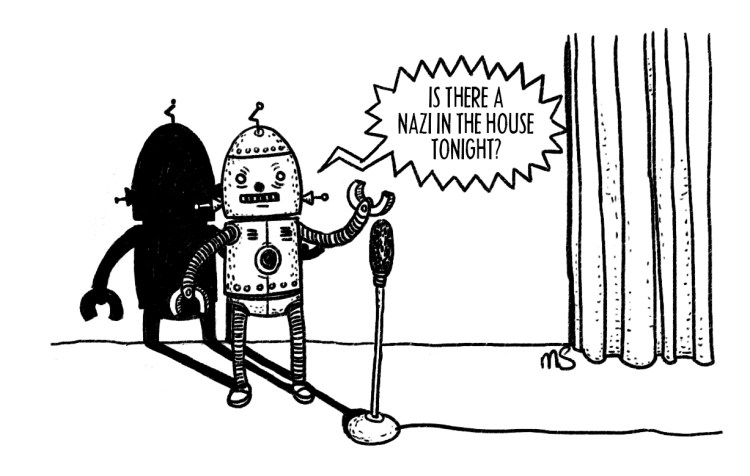
“Sometimes you can’t see yourself clearly until you see yourself through the eyes of others.”
Ellen DeGeneres
Many years ago there was a small stand-up comedy club called Cool Runnings in Melville, a suburb of Johannesburg. It was like a tiny sweaty cave where almost every comic worth his or her salt would do a set.
My friend Oscar Strauss and I were going to make a short film about a comic who had never been on stage. We followed him around for a couple of days, watching him rehearse and interviewing him about his material. Then came the big night. Within 30 seconds we realised this might be the worst idea we had ever had. This guy was ridiculously bad. I actually stopped filming because I was so embarrassed. He wasn’t funny so any empathy you had for him from the interviews went out the window. So, we ended up with a film without an ending.
But because of this doomed project I spent a lot of time there. And one night, I think it was Open Mike night, an interesting event happened. An older man got up and began to tell jokes. He was metronomic in his pace and didn’t listen to the audience. It was like he was reciting a shopping list. And because of this, the jokes just weren’t funny. You could see he had rehearsed over and over. He was robotic. Nothing would stop him. Even as the ice-cubes that were being thrown hit him in the face, he just kept going. He had made two cardinal sins. He had ignored and wasn’t listening to his audience. And, he had eliminated any shred of humanity out of his performance.
Humanity is a very underrated quality.
This is something Microsoft found out this week. They created what they called an artificially intelligent Chatbot called Tay. They released it online and within 24 hours it had become a holocaust denying racist. It was programmed to learn from interactions it had with real people on twitter. And, as you can imagine, they fed it the most racist, offensive stuff they could. A perfect algorithm, destroyed by a couple of trolls in a single day.
This shows us two things. Firstly, people very seldom do what you want them to do. They are unpredictable, so you better have more than one approach, as most great comics do.
Secondly, artificial intelligence, not to mention human intelligence, seems to really struggle with context. Which of course is everything. Just ask Microsoft.
The power of context. Comics are not just funny because of what they say. They are funny because of how they say it. And when they say it. This comes from listening. Perhaps the most human thing we can do.
My entire advertising career has been about listening and understanding context. You have many long conversations when making a commercial or piece of content. You lock down the art direction, the lighting, the script and storyboard.
And guess what always becomes tricky? The tone. The context. I have spent years in meetings where either the client, director or the agency normally end up saying this phrase:
“That’s not how I saw that in my head.”
And that is after many rounds of discussion and research. So, like that metronomic comic from all those years ago you can have all the information and still not get it right because the picture you are painting is not what your audience is seeing. A great comic makes you see the same picture he has in his head. Great creatives can do the same.
This is very seldom done just with information or data. At best, that just gives you a starting point or target. At worst you get Tay. As Einstein said information is not knowledge. You still have to do something that transforms information into an idea. Information doesn’t connect, ideas do.
What normally gets you there is a common human experience, a shared feeling and let me stress this, really listening. Humanity or a word I like, humanness. This sadly seems to be something people in our business are frightened of these days. People are far happier believing there is a clinical, logical process or list to create what every brand wants. Emotion and feeling. This is madness.
This is what I often find so strange about our business. Imagine advertising was stand-up comedy. There would be a huge amount of thought put into the venue. The food would be good. Fantastic wardrobe. Great lighting. There would be weeks of discussion and research as to how you create the perfect jokes. They would be written down and then read out perfectly by someone with perfect teeth. Everything would be perfect.
Nobody would be laughing though because we would have forgotten one thing.
Human beings don’t want perfection. They want connection.
“There is science, logic and reason;there is thought verified by experience. And then there is California.” Edward Abbey I read two articles this week which I found pretty interesting. …
 “There is science, logic and reason; there is thought verified by experience. And then there is California.”
Edward Abbey
I read two articles this week which I found pretty interesting. The first was a piece in the Telegraph. It was about how television spend in the UK had exceeded 5 billion pounds for the first time. In the article it mentioned the biggest new spender on television was Facebook spending 10.8 million pounds. It also mentioned that Google, Netflix and Facebook spend 60 percent of their marketing spend on television trying to give their brands some emotion and feeling. 60 percent. I will let that sink in for a while.
The second article was in an American publication (I think it was The Huffington Post) and it spoke about the differences between Donald Trump and Hillary Clinton. In essence, the articles point was that Hillary Clinton didn’t have a logic problem, she had a feeling problem. People might agree with her but they don’t feel very much. Her brand makes sense logically but for many there is no connection emotionally. Then there is Donald Trump.
Now, let me nail my colours to the mast. I am no fan of Donald Trump. Like, at all.
For many, when he started he was seen as a joke. We all thought he stood no chance. Even to this day he has almost no clearly articulated policies apart from building a large wall that he believes Mexico will pay for. Yet, despite this, he has been enormously successful. And this success goes against pretty much every poll that was taken earlier this year. The logic said he had no chance. Research got it very wrong. So, what does he have? The simple answer is emotion. Feeling. Watch any Republican debate and you will see how Trump makes the other more rational candidates seem boring. They were like beige, frightened cardigans who didn’t know if they should push their sleeves up or leave them down. They prepared for a polite debate. He turned it into a street fight.
And the street fight has continued as you can see by the unfortunate events in Chicago. He is either loved or hated in equal measure. He has been compared to Hitler. He often says things that no other politician would dream of saying. And, on the flip side, his supporters adore him because they say Trump tells it like it is All this has created emotion that has fuelled the media to such an extent that he has had to spend virtually nothing on advertising. This emotion has changed just about every rule of running a political campaign and creating political advertising
What he has proved is that something can be logical, make total sense, yet struggle to break through because ultimately when it comes to human beings, emotion will always trump reason. No pun intended.
So, with that in mind, perhaps the media spend of Google, Netflix and Facebook in the UK makes a bit more sense. I think they are obviously trying to reach the mass market and trying to grow quickly which obviously says a lot about the power television has as a medium. However, there is another lesson for me. They need emotion.
As a brand you can make total sense, you can have a great product and can be very useful but you better make people feel something.
The three brands I have mentioned are extremely useful and totally dominate the landscape. But of course the world changes. Just Ask Jeeves. And, if you have a number of competitors that are as useful as you, what do you do then? Perhaps this explains why very modern, very rational tech brands are making these choices. They need people to feel something about them.
I am aware what I am saying is very unfashionable. For the last couple of years as an industry we have tried to become useful in new ways. Re-invent ourselves. We have created a lot of very useful products and apps. There is also a drive towards the rational. We have become a little wary of what our killer app has always been.
Creating pure emotion.
However, if there is anything to learn from the Trump campaign and perhaps the strange media spend of some giant tech brands, it is this:
The power of emotion rather than logic is still the biggest disruptor of them all.
 Damon's Brain